Amansultan · EdTech · Internal tools
Scaling the library by limiting what could go in it
ROLE
Lead Product Designer
DATE
2025 — 2026
PLATFORM
Web
The content team was producing lessons at 45-100 hours each, across five roles, with problems caught only at the end.
The fix wasn't hiring or training. I redesigned the editor's architecture — and the production flow shifted with it. Per-lesson effort dropped by roughly half and one role left the chain entirely. The new editor went live without a training plan.
Context
Amansultan needed +200 lessons per quarter. The production system wasn't built for it.
Amansultan delivers interactive lessons to primary schools across Kazakhstan. By 2025 contracts depended on growing lesson library — fast.
I joined to design the teacher- and student-facing platform. The bottleneck wasn't there. It was one layer down: a legacy editor with no pipeline behind it. Engineering hadn't touched it. I picked it up.

45-100 hours per lesson · 5 roles · problems found late.
Discovery
9 interviews, a survey of 100+ teachers, dozens of shadowed sessions, three months of logs. Three patterns flipped the assumption that the team was slow.
Finding 1
Rework wasn't a side-effect — it was a phase
The editor had no slide-level preview. Defects surfaced only at the end.
"I couldn't tell which slide was which — just numbers and titles, no preview of the content."

The sidebar after a methodologist's full draft.
Finding 2
The editor was foreign to the people writing the content
Methodologists drafted in Google Docs. A separate role existed only to move the content into the editor's fields.
"I don't understand what these fields mean — it's easier to type it up in the Doc and hand it off."

Second tool is Google Doc, no shared structure with editor.
Finding 3
A small set of mechanics, rebuilt from scratch every time
The library was built from a fixed set of mechanics — six in the current editor, plus more in the legacy one that couldn't share content with it. Every lesson reused the same mechanics. Production rebuilt each instance from scratch.

Six mechanics, 700 lessons, no reuse.
Design thesis
One shared core meant changing any mechanic risked breaking all the others
One core meant a change to any mechanic could break unrelated ones. Six mechanics, hundreds of lessons, no way to share content between editors — the library was already telling us where templates should live. Each mechanic now lives in an isolated template — the smallest unit of change.

From a shared core to isolated templates. Mechanics no longer affect each other.
Design thesis
Methodologists drafted in Google Docs because the editor wasn't built for them
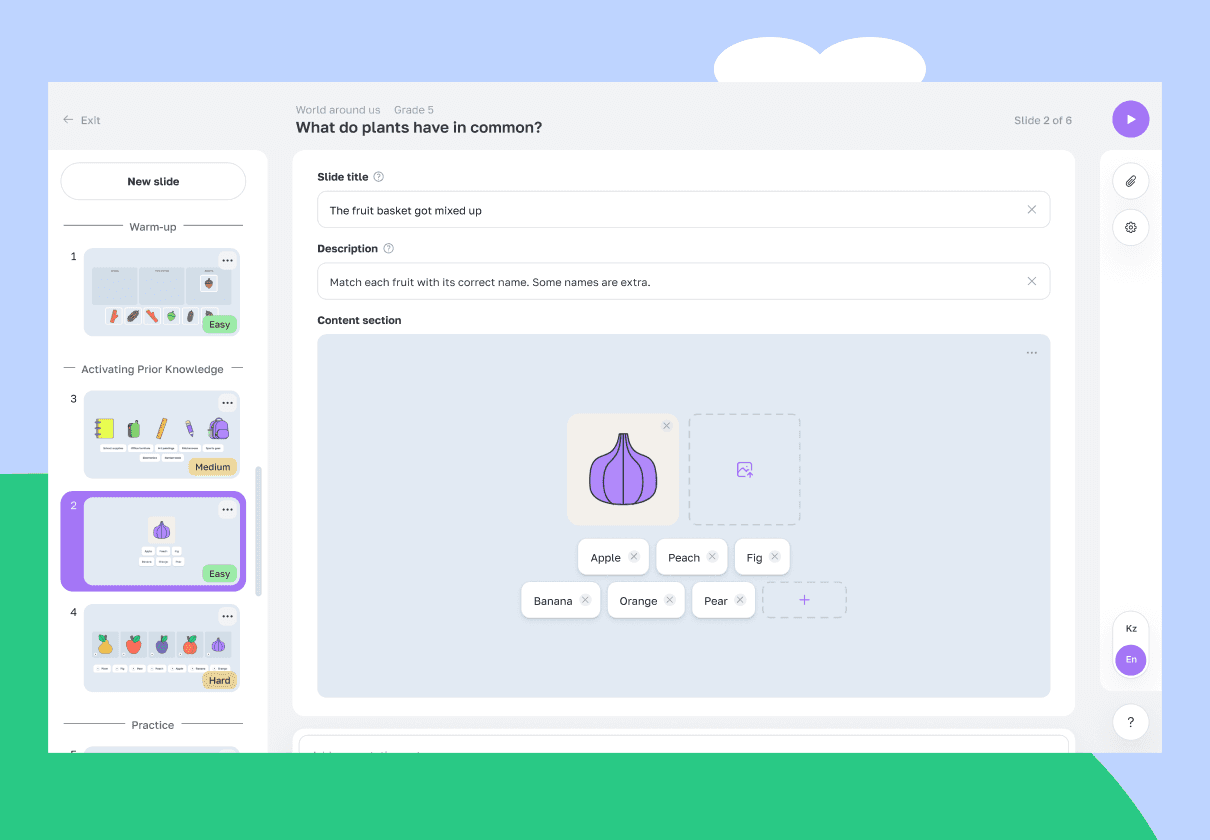
Methodologists drafted in Google Docs because the editor wasn't built for them. The new editor makes the lesson outline a first-class object — they draft directly inside it.

The methodologist starts where they used to hand off.
Design thesis
The legacy editor hid the result — you only saw it after the rework
The legacy editor hid the result until rework. The new editor renders every template the way a student sees it, inline, as content is entered.

What you see is what the student sees.
Validation
A two-hour prototype proved the approach before engineering committed
Before engineering committed to the modular architecture, I built a browser demo over two hours using the Figma API — a Figma frame URL in, draggable editable blocks out. It was crude, but it gave engineering a concrete reference, surfaced the approach's limits before they became code, and shaped the spec for the first production template.

Two-hour validation prototype. Frame URL in → draggable interactive blocks out.
Constraints
Constraints Headline: Each pivot came with a cost we accepted
Constraint 1
I argued for a universal editor. We shipped a templated one. A single composable canvas would have absorbed any mechanic without new templates. Engineering pushed back on scope. We shipped modular templates, universality on the roadmap. Still the trade I'd revisit first.
Constraint 2
Custom mechanics became engineering work. A park scene with sortable animals became either 1-2 weeks of engineering or the existing group-sorting template. We chose the template.
Constraint 3
700 legacy lessons couldn't auto-convert. A six-week migration we hadn't planned for.
Visual: None. Text-only by design.
Outcome
The chain lost a role, and the remaining ones got their time back
Assembly time dropped ten-fold. Methodologists now publish to the platform themselves — the content manager role dissolved. Throughput rose from 4-6 lessons per week to 10-30. No training session was needed at handover.

Five roles → four. One tool replaced one role.
Reflection
The universal editor was the right idea — I should have pushed harder.
A composable canvas would have absorbed most one-off requests. Next time, that's the proposal — not the fallback. Methodologists belonged in discovery from day one. The scaffold-in-editor was a retrofit. Analytics should have shipped with the templates. I still can't tell which carry the library and which sit unused.